

Artificial Intelligence
AI Assistants Can Now Talk Directly to Company Data
Databricks and Apple just plugged AI assistants into company data using MCP. What that changes for data analysts, and the skills worth learning now.
 Sachin BhatnagarChief @ StackSauce7 min read
On this page8 sections
AI Assistants Can Now Talk Directly to Company Data. What Does That Mean for Data Analysts?
Two announcements landed on the same date recently, and together they tell an important story for anyone learning data analytics.
On 27 October 2026, Databricks made it much easier for AI assistants like ChatGPT, Claude, Codex, Claude Code and Cursor to connect to company data stored on its platform. On the same day, Apple announced that the Numbers spreadsheet app is getting an AI assistant that "calculates, visualizes, and organizes data" and recommends chart types. Apple also said that outside AI agents will be able to read and edit files inside Keynote, Pages and Numbers. Both announcements rely on the same three letters: MCP.
If you are learning data analytics, you might be feeling a small knot in your stomach right now. If anyone can ask an AI a question about company data, what is left for the analyst to do?
That is a fair question. Let me explain what is happening in simple words first, and then give you my honest opinion.
First, some quick definitions
Let me clear up a few terms before we go further.
- Databricks is a platform where large companies store and analyse huge amounts of data. Think of it as a giant, organised warehouse for a company's numbers.
- An AI assistant is a tool like ChatGPT or Claude that you can talk to in plain language.
- An AI agent is an AI assistant that can also take actions. It can run a query, open a file or edit a document for you.
- OAuth is a safe way to let one app sign in to another without sharing your password. When you click "Sign in with Google" on a website, you are using OAuth.
What is MCP, in plain words?
MCP stands for Model Context Protocol. A protocol is simply an agreed set of rules for how two things communicate.
Here is the easiest way to picture it. Think back to the days when every phone had its own charger. Nokia had one shape, Samsung had another, and your friend's phone needed a third. Then USB-C came along, and one plug started working for almost everything.
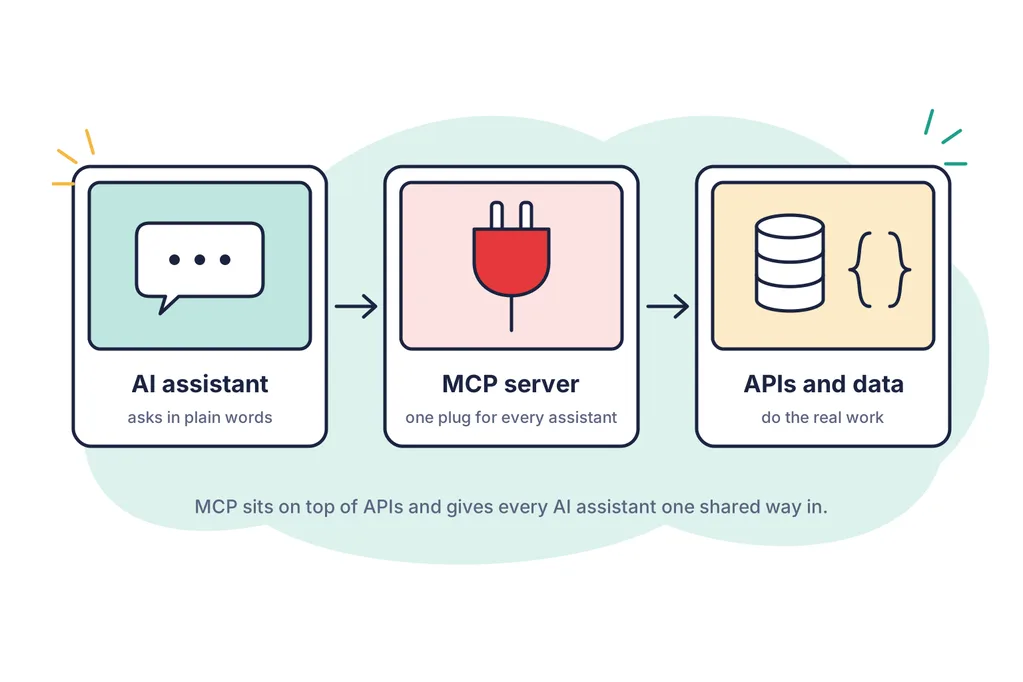
MCP is trying to be the USB-C port for AI. Before MCP, every AI tool needed its own custom connection to every data source. That was slow and expensive. With MCP, a data platform builds one MCP server, and many different AI assistants can plug into it.
One small but important detail: MCP works on top of APIs. An API is a set of rules that lets two pieces of software talk to each other. APIs still do the actual work underneath, and MCP gives AI assistants one common plug to reach them.
What exactly changed with this announcement?
Here are the main pieces, from the companies' own announcements.
Databricks. According to its release notes dated 27 October 2026, ChatGPT, Codex, Claude, Claude Code and Cursor can now connect to Databricks MCP servers using ready-made sign-in apps. Before this, a company admin had to set up a custom OAuth app first. That might sound like a tiny technical change. In practice, removing a setup step like this often decides whether people actually use a feature.
Apple. Apple's press release from 27 October says the new assistant in Numbers "calculates, visualizes, and organizes data", recommends suitable chart types with a one-tap preview, and builds custom tables. Apple's new MCP support lets outside AI agents "read content, perform edits, and execute automated actions" in Keynote, Pages and Numbers. This needs macOS 27, and the assistant is in beta and in US English only for now.
Qlik. Qlik is a well-known business intelligence company. Business intelligence, or BI, means tools that turn company data into dashboards and reports. Earlier this year, Qlik launched an MCP server that lets assistants including Anthropic's Claude use its analytics and trusted data. It has since made that server available through the AWS and Databricks marketplaces.
Put these together and the direction is clear. AI assistants are being wired straight into the places where company data lives.
What this changes for everyday work
Today, a sales manager wants to know last quarter's sales in Pune. They message the data analyst. The analyst writes a SQL query, which is a question written in a language that databases understand. Then they make a chart and send it back. This can take an hour, or two days if the analyst is busy.
Tomorrow, the same manager might type the question into Claude or ChatGPT. The assistant connects to the company's data through MCP, runs the query and draws the chart in thirty seconds.
So yes, this kind of simple lookup work will shrink. I will not pretend otherwise.
So are data analysts finished?
Now most will say, "That's it. Data analysts are finished." Partly agreed, for one narrow kind of work. If your whole job is pulling the same report every Monday, that job is in trouble.
But let me ask you a simple question. When the manager asks for "sales", what does sales mean?
Does it include returned orders? Does it include tax? Is it counted on the day of the order or the day of payment? Does the Pune number include the new branch that opened last month? Every company answers these questions differently. Sometimes two departments inside the same company answer them differently and then fight about it in meetings.
The AI only knows what the data and the definitions tell it.
Qlik's own announcement makes this point. It warns that many companies are "still forcing assistants and agents to work with incomplete business context, duplicated analytics logic, and ungoverned data." Governed data simply means data with clear rules. Who is allowed to see it? Where did it come from? What does each number mean?
Without that, the AI will happily tell your CEO that revenue went up 300%. It will not mention that someone counted every order three times.
This is where the analyst's job moves. A growing share of the day will go into making sure the numbers mean the right thing. That includes building clean data tables, writing clear definitions for each metric, setting up checks, and deciding who can see what.
Databricks seems to agree that control matters. On 19 October, it added a way to filter data for each user, so people only see what they are allowed to see. On 21 October, it added a beta feature to screen MCP tool calls for jailbreaks. A jailbreak is when someone tricks an AI into breaking its own rules.
What this means for you
If you are learning data analytics right now, here is my practical advice.
- Learn SQL properly. Please do not skip it because "AI writes SQL now". You need to read and check what the AI writes. In the Stack Overflow 2026 Developer Survey, SQL was used by 58.4% of developers, ahead of HTML and CSS. It is going nowhere.
- Learn to define metrics. Pick any small dataset and write down, in plain English, exactly what each number means. It may sound boring. I think it is the skill that will set good analysts apart.
- Learn the basics of data modelling. Data modelling means deciding how data is organised into tables and how those tables connect. A well-organised model is what makes AI answers trustworthy.
- Try MCP yourself. Connect an AI assistant to a small practice database and ask it questions. Then write the same SQL yourself and compare the answers. When they do not match, find out why. You will learn a lot from those moments.
- Practise explaining numbers. The analyst who can say "Sales went up, and here is the real reason" in two simple sentences will always be in demand.
A short closing thought
Every big shift in tools has changed what analysts do. Spreadsheets did it. Dashboards did it. Now AI assistants are doing it.
The boring part of the job is getting automated, and to be frank, I do not think many analysts will miss it. The part that remains is understanding the business, defining what the numbers mean and protecting the truth in the data. That part needs a thinking human, at least for now.
So keep learning, and start asking yourself one new question every day: "How do I make sure this number is right?"
Topics
- Careers in Data
- Data Analytics
- MCP
- AI Agents
- SQL

Written by
Sachin B
Chief @ StackSauce
Founder at Studio 8 Collective
Sachin is a tech educator, developer, and builder with over 22 years of experience in technology and technical education. Currently serving as Academic Head at PW Skills, he has spent much of his career teaching, designing learning experiences, and helping aspiring developers make sense of complex technologies. Over the past two decades, he has worked closely with some of the most prominent names in Indian and global technical education, including SitePoint Premium, Udemy, upGrad KnowledgeHut, and PhysicsWallah (PW). These experiences have given him a firsthand understanding of how technical education is created, delivered, and consumed, but more importantly, where it often falls short for learners. That understanding led him to build StackSauce, an independent platform that allows him to connect directly with learners, educators, and fellow technology enthusiasts. StackSauce is his sincere attempt to address some of the challenges he has observed throughout his career: unnecessarily complicated explanations, fragmented learning experiences, and an emphasis on completing courses rather than developing genuine understanding. At the heart of StackSauce is a simple belief: technical education should be accessible, practical, and grounded in first-principles thinking. The goal is not merely to teach people how to use a technology, but to help them understand why it works, how its underlying concepts fit together, and how to apply that knowledge independently. Sachin remains a hands-on developer and an endlessly curious experimenter. He continues to build, experiment, and teach, while conducting developer workshops on emerging technologies. He has a particular interest in how AI is changing the way software is built and learned. His curiosity extends well beyond software. He enjoys tinkering with electronics, hardware, and DIY projects, particularly when an idea calls for a little soldering, some programming, and a fair amount of trial and error. He also loves writing whenever he can find the time and is an aspiring drone pilot, adding yet another pursuit to an already long list of interests. At StackSauce, he wears two hats: the architect behind the platform and a Tech Chef who contributes to it. He believes good technical content should respect the learner's intelligence, avoid unnecessary jargon, and make even difficult concepts enjoyable to explore. Based in Chandigarh, Sachin is rarely without a project, an unfinished experiment, or an interesting problem to solve. And when he's away from his keyboard or workbench, you're quite likely to find him at the polo ground, watching his daughter play Arena Polo.