

Artificial Intelligence / The Forward Deployed Engineer, part 2
The FDE Skill Stack: What to Learn, and in What Order
A simple, layer by layer learning order for becoming a Forward Deployed Engineer, built from what hundreds of FDE job posts actually ask for.
 Sachin BhatnagarChief @ StackSauce9 min read
On this page12 sections
The FDE Skill Stack: What to Learn, and in What Order
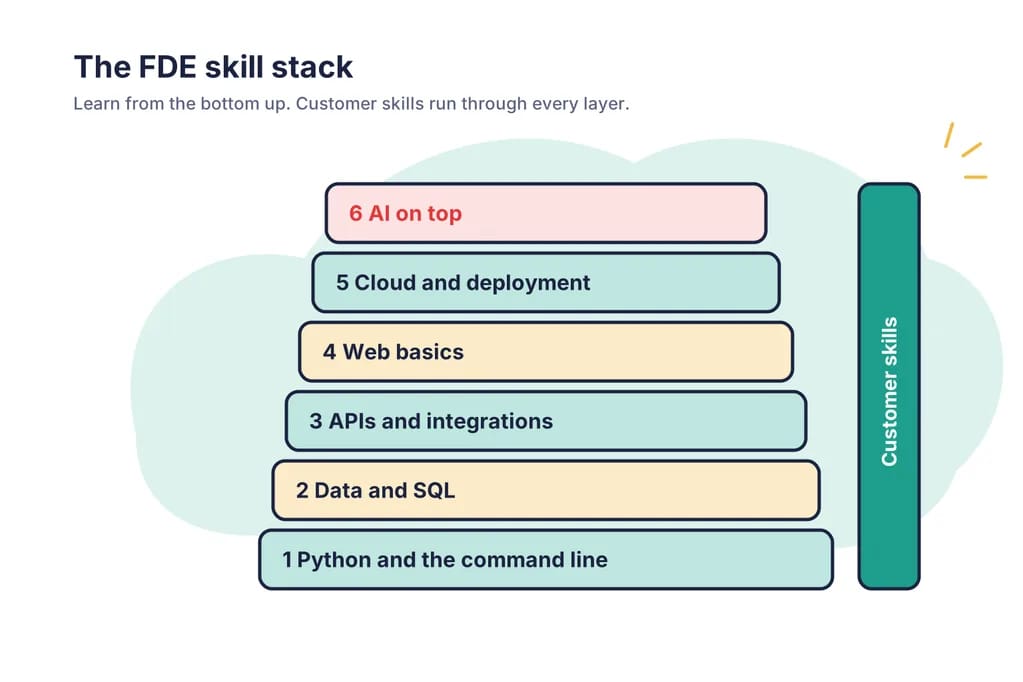
In Part 1, I explained what a Forward Deployed Engineer does. An FDE works close to the customer and makes a product fit that customer's real, messy problem. I also showed you the skills FDE job posts ask for. That list had one problem. A list has no order. Python, APIs, cloud, SQL, React, AI, communication. If you sit down on a Monday morning and try to learn all of it, you will be exhausted by Wednesday and you will have learnt nothing properly. So in Part 2, I want to turn that list into a learning path of six layers, in the order I would teach them. None of the job reports I have read suggest a learning order, so this one is my own, from many years of teaching beginners. Feel free to argue with it.
First, what the job numbers say
Rung, a site that tracks FDE hiring and which I also used in Part 1, counts 391 open FDE roles across 13 companies. Databricks has 121, Palantir has 105 and Salesforce has 88. The exact count moves up and down a little, but the shape of it stays the same. A second source gives the bigger picture. FDE Council, a group that writes about this role, published data from Lightcast, a company that studies job postings. US FDE postings went from about 200 in 2024, to around 1,200 in 2025, to more than 5,200 in just the first seven months of 2026.
Why the order matters
Think about building a house. You pour the foundation first. Then the walls go up, followed by the wiring and plumbing. The furniture comes last. Nobody buys a sofa before the floor exists. Skills work the same way. Every layer leans on the layers below it, so each new layer feels easier when you learn them in order.
Layer 1: Python and the command line
Python is a programming language known for being easy to read. In Rung's count, 78% of FDE posts ask for it. In Lightcast's count, it is 57%. Either way, it is the most requested programming language for this role. At this stage, learn the basics really well. Variables, loops, functions, lists and dictionaries. How to read and write files. How to read an error message calmly and understand what it is telling you. Along with Python, learn the command line, the plain text window where you type instructions to your computer. Also learn Git, a tool that saves versions of your code so you can go back when something breaks, and something always breaks. You are ready to move on when you can write a small script that reads a file, changes something in it, and saves the result, without copying the whole thing from a tutorial.
Layer 2: Data and SQL
In Rung's report, 52% of posts ask for data skills, SQL or pipelines. SQL is a language for asking questions to a database. A pipeline is a series of steps that moves data from one place to another and cleans it on the way. Why second? Every customer has data, and it is always messier than they told you. Dates in three formats, names spelt four ways, and a column called "final_v2_new" that nobody remembers creating. Learn the core of SQL first: SELECT, WHERE, JOIN and GROUP BY. Then learn to load CSV files (simple tables saved as text) and JSON files (a common text format for structured data) in Python. You are ready to move on when you can take a messy spreadsheet, clean it, put it in a database and answer five real questions from it.
Layer 3: APIs and integrations
An API is a set of rules that lets two pieces of software talk to each other. Integration means connecting a product to the systems a customer already uses. Rung puts this at 64% of posts. Honestly, this is the heart of FDE work. Most of your days will be spent making one system talk to another system that was never designed to talk to anyone. Learn how a web request works, and what an API key is (a secret password that lets your code use a service). Call a real public API from Python. Then learn to handle errors, slow responses and limits on how many requests you can send, because all three will happen. You are ready to move on when you have connected two real services, for example a weather API and a spreadsheet, and your code handles failures politely.
Layer 4: Web basics
JavaScript, React or TypeScript show up in 58% of Rung's posts. JavaScript is the language of the web browser. TypeScript is JavaScript with extra checks that catch mistakes early. React is a popular tool for building web pages out of small reusable pieces. For an FDE, you need enough web skill to build a simple screen that non-technical people can use. The claims manager at an insurance company is never going to run your Python script from a command line. Give them a page with a button. One small React app with a form, a table and a call to your own API is plenty for now. You are ready to move on when someone who cannot code can use your tool without calling you for help.
Layer 5: Cloud and deployment
Cloud means renting computers over the internet from companies like AWS, Google Cloud or Microsoft Azure. Rung counts it in 62% of posts. Deployment means putting your code on one of those computers so real people can use it. Learn to deploy one small app. Learn about environment variables, which are settings like passwords that you keep outside your code. Learn to read logs, which are the messages your app writes about what it is doing. Learn Docker basics. Docker packs your app and everything it needs into one box that runs the same way everywhere. You will hear people talk about Kubernetes, a tool for running many of those boxes together. It shows up in only 9% of Rung's posts. Park it for later, along with training your own AI models. You are ready to move on when your app runs on the internet, you can update it without breaking it, and you can find out why it crashed by reading the logs.
Layer 6: AI on top
Now the exciting part. Rung finds that 32% of posts mention LLMs or generative AI. An LLM, or large language model, is an AI system trained on huge amounts of text, like the ones behind ChatGPT and Claude. Lightcast, on the other hand, finds "artificial intelligence" in 70% of postings. Why such a big gap? FDE Council gives a fair explanation. The word "AI" in a job post can mean building AI, testing AI or simply using AI tools. Lightcast's broad label catches all three. So both numbers can be right at the same time. At this layer, learn to call an LLM through its API, which is easy because you already know APIs. Then learn RAG, short for retrieval augmented generation. RAG means you find the right documents first and give them to the AI along with the question, so it answers from the customer's own data. Then learn the basics of agents, which are AI systems that can take steps and use tools on their own. One more thing, and this one is my opinion. Learn how to test whether an AI answer is good. People call this "evals". FDE Council notes that evaluation hardly appears in the top skills in job posts. In my view that is a gap in the job posts, and you should fill it anyway. The first question every serious customer asks is, "How do we know this thing is giving correct answers?" The FDE who can answer that calmly wins the room.
The thread that runs through every layer
Rung found that 99% of FDE roles are customer-facing. Lightcast lists communication in 45% of posts and problem solving in 40%. These skills run through every layer of the stack, from the first to the last. So practise them from your first week. After every small project, write a one-page note for a non-technical reader: the problem, how to use the tool, and what can go wrong. Then explain it out loud to a friend who does not code. If their eyes glaze over, rewrite the note. Another pro tip is to try to teach what you've learnt to someone. It could be your office colleague, your friend or your sibling. When you teach, you automatically become good at articulation and breaking down concepts such that your brain wires up to grasp better.
"But I want to start with AI"
Now most will say, "Sir, AI is the hot part. Why should I wait until layer six?" Partly agreed. Use AI tools from day one. Let them explain errors, review your code and quiz you on SQL. They never get tired of your questions. Building AI for paying customers is a different matter. When an AI feature fails at a customer's office, the cause is very often a layer below it. Dirty data, an API that timed out, a password missing on the server. If you skipped those layers, you will stare at the screen and blame the model, and the customer will stare at you.
What this means for you
Pick one layer at a time. Stay on it until you pass its "ready to move on" check. Moving up too fast is the most common mistake I see in self-taught learners. Build one project that grows with you. Start with a Python script in layer 1. Add a database in layer 2, an API in layer 3, a web page in layer 4, deploy it in layer 5 and add AI in layer 6. By the end, you have one real project with six layers of proof. Write the one-page note every time. This is your customer skills practice, and it will become gold in Part 3.
How long will all this take? Honestly, it depends on your hours and your starting point. Treat it as months of steady work. Anyone promising you an FDE job in thirty days is selling a course, and probably a bad one.
Topics
Article series
The Forward Deployed Engineer
3 parts / Part 2 of 3

Written by
Sachin B
Chief @ StackSauce
Founder at Studio 8 Collective
Sachin Bhatnagar is a developer, technical educator, and industry expert with more than 22 years of experience across software development, technical education, and media and entertainment. His time in media and entertainment included work in animation and visual effects. He taught his first class in 2002. Since then, Sachin has built software, designed technical programs, and taught learners at different stages of their careers. He has worked with some of the most prestigious organizations such as Maya Academy of Advanced Cinematics (MAAC), Frameboxx Institute of Emerging Media, SitePoint Premium, Udemy, upGrad KnowledgeHut, and PhysicsWallah. He founded StackSauce to help people learn technology with more clarity and confidence. His approach is simple. Start with what learners already know, explain why things work, and give them a chance to build something of their own. He believes even a difficult idea becomes easier to explore when you have a clear place to start. Based in Chandigarh, Sachin enjoys writing, tinkering with electronics, and taking on DIY projects. He’s an aspiring drone pilot and is often at the polo ground, cheering on his daughter as she plays arena polo.